Five years running everything digital for a trade laminator, and the online shop that carried the business through COVID
Express Encapsulation is a trade laminator and encapsulator. They take print from commercial printers, design agencies and print shops and make it last, so the menus, maps, signs and point of sale that would otherwise get wrecked in a week come back protected. They’d been doing it for over thirty years when I started working with them in 2018, and they had the problem a lot of good trade businesses have, which is that everyone who already knew them loved them and nobody else could find them.
It’s the longest client relationship I’ve had and the one where I did the widest range of things, and I’m including it for both reasons. But the part worth reading is what happened in April 2020.
Where it started
Sales had been declining. The website didn’t say what the business did in a way a new customer would understand, and it didn’t turn up when they searched. Quotes came in by phone and email and got answered from memory. The office ran on a router somebody had plugged in years ago, files lived on individual machines, and the phone system was tied to the building.
In 2018, the year I started and the year the new site launched, they invoiced 367 different trade customers for £689,000. That’s a real business with a loyal base. It just wasn’t growing, and it wasn’t set up to.
What I built
I’ll list it, because with this client the list is half the story.
A new position. The business had always described itself by what it did, which is laminating and encapsulating. I repositioned it around what that does for the customer, which is making print last longer and look better, and rebuilt the brand identity and the product catalogue around that.
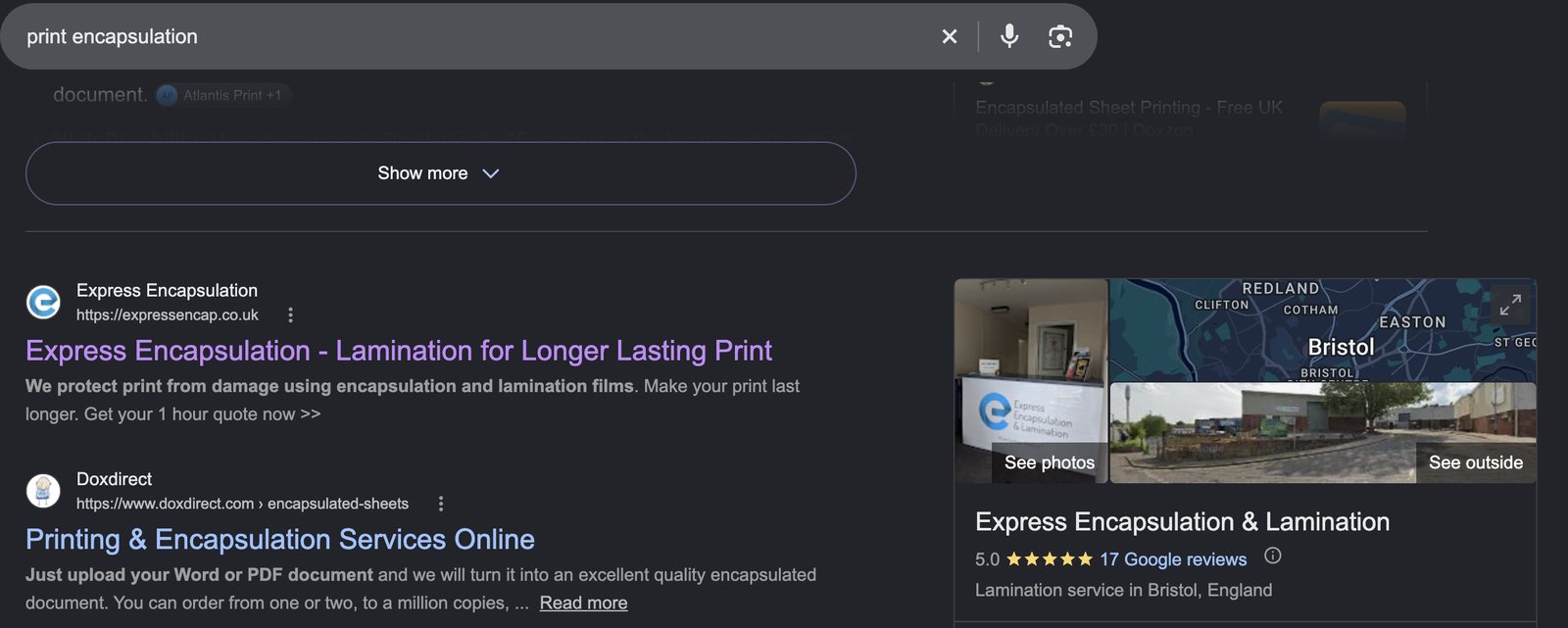
The website, rebuilt from scratch, in 2018. Structured around the customer’s problem rather than the product list, with quote requests and sample ordering built in, and the technical work done so it could be found. It went to number one on Google for “print encapsulation”, and it’s still there. I checked on the day I wrote this, eight years after it launched.
An online shop. Trade customers who buy laminating film on repeat don’t want to ring up for it, so I built them a shop to sell film direct. That’s what it was for. It’s not what it ended up being remembered for.
A CRM and the email marketing to go with it. HubSpot, set up so the team could manage leads, schedule follow-ups, move people through lifecycle stages and segment the customer list. Then regular email campaigns to that list for product launches and promotions, and direct mail to the trade as well, because printers still open post.
Some PR. Trade press and local coverage to support the repositioning.
The IT, in-house. New modem and router setup, Google Drive for shared documents so files stopped living on one person’s machine, and the phone system migrated to the cloud so it stopped being tied to the building. None of that is marketing. All of it is the difference between a business that can grow and one that can’t, and it was cheaper for them to have me do it than to find three other suppliers.
The decision I’m most pleased with
In April 2020 the country locked down and the print trade stopped. Express’s sales that month were £7,543. Encapsulation, which was the whole business, did £1,676. A company that had turned over £728,000 the year before had, for practical purposes, no customers.
What they did have was a stock of plastics, the machines to cut and form them, and an online shop I’d built to sell laminating film that nobody was buying. So we repurposed it. The same materials that protect a menu will make a face visor or a screen, and within weeks the shop was selling PPE and sanitation products made from the plastics they already had, to a customer base that already trusted them, through the email list that had been built for a different purpose.
May 2020 was £167,561. That’s the biggest month in five years of accounts, in the month the rest of the trade was on furlough, and £153,689 of it was PPE through the shop. June was £114,803. July was £88,661. By the autumn the trade customers were starting to come back and PPE was tailing off, which is exactly how it should have gone.
It saved the business. I don’t use that phrase lightly and I wouldn’t use it if the numbers didn’t show it. The shop had been a sensible piece of work that made ordering film easier. For about six months it was the reason the company still existed.
What the numbers say
The client’s own sales summaries, by year:
| Total sales | Core business, excluding PPE | PPE | |
|---|---|---|---|
| 2018, launch year | £689,000 | £689,000 | 0 |
| 2019 | £728,000 | £728,000 | 0 |
| 2020 | £801,000 | £489,000 | £312,000 |
| 2021 | £754,000 | £579,000 | £175,000 |
| 2022, January to October | £680,000 | £672,000 | £7,500 |


I’d rather explain those than tidy them up.
The first full year after the launch, sales were up 5.7% on the launch year. That’s not a dramatic number, and I’m not going to pretend it is, but it was growth in a business whose sales had been going the other way, and it came from the site and the shop bringing in customers who’d never heard of them.
Then in 2020 the core business fell by a third, which is what happened to every print business in the country. The PPE sold through the shop put £312,000 through the books and kept the year above 2019. In 2021 the core started coming back and PPE was still contributing. By 2022 PPE had gone, and the core business was running at about £807,000 a year, roughly 10% above where it had been before the pandemic.
Encapsulation itself, the main service, went from £595,000 in 2019 down to £391,000 in 2020, back to £454,000 in 2021, and was running at about £620,000 a year by 2022.
So the honest description isn’t that sales went up in a straight line after the launch, although over the five years they did go from £689,000 to about £815,000. It’s that a business which had been set up properly, with a shop, a list and a way to reach people, could turn round in a fortnight when it had to, and came out the other side bigger than it went in.
What the client says
Two people from the business, six years apart.
“Gavin at Fluxify has implemented our marketing strategy from the ground up, including: website development, CRM system, e-mail marketing, IT infrastructure and sales automation, with fantastic results. Would highly recommend.”
David BrantonProduction Manager, in a Google review from around 2020
“Gavin managed our website rebuild, SEO, and IT systems, which made a real difference. He communicated clearly, delivered on his promises, and dealt with any issues quickly and professionally. Since completing the work, plus while working on other long-term projects with us, our search visibility has improved, the website performs better, and our IT systems are far more reliable. Gavin was knowledgeable, dependable, and easy to work with. I would have no hesitation in recommending him to any business looking for support with web, SEO, and IT projects.”
Chloë McGuireExpress Encapsulation and Lamination, in 2026
How it was built
This one predates the way I build now. The website, the shop and the CRM were built and configured by me, hands on, on the tools a business that size can afford to run. The IT and the phone migration were done in person, in the building. It’s worth saying because it’s the counter to the idea that I only do the big-systems work. I’ve done the router.
What this looks like for your business
If you run an established trade or owner-managed business, the thing holding you back probably isn’t one problem. It’s a website that doesn’t say what you do, plus a quote process that lives in someone’s head, plus files on one machine, plus a phone system from another decade, and none of those is big enough on its own to hire someone for.
The approach is to treat them as one job. Fix the position first, because everything else hangs off it. Then the site, then the systems that catch the enquiries the site produces, then the infrastructure underneath so it all keeps working when you’re not looking. And build it so that when something you didn’t plan for happens, you’ve got somewhere to sell from.
Between them that’s the website, the search and the systems, run as one job over five years, which is what the retainer on the contact page is for.
Tell me what’s not working.
I’ll tell you whether I can help and roughly what it would involve.